AI/MLFeatured
UrbanCare AI
AI-Native Clinical Ecosystem for Mechanistic Interpretability
The problem
Most clinical AI is a black box — physicians can't audit how a diagnosis was reached, so they can't trust it and compliance teams can't sign off on it.
My approach
A Semantics-to-Vector interface that bridges human-readable clinical semantics and internal model vectors, making every layer of the 30-agent pipeline inspectable — from lab-report extraction to differential diagnosis.
What I built
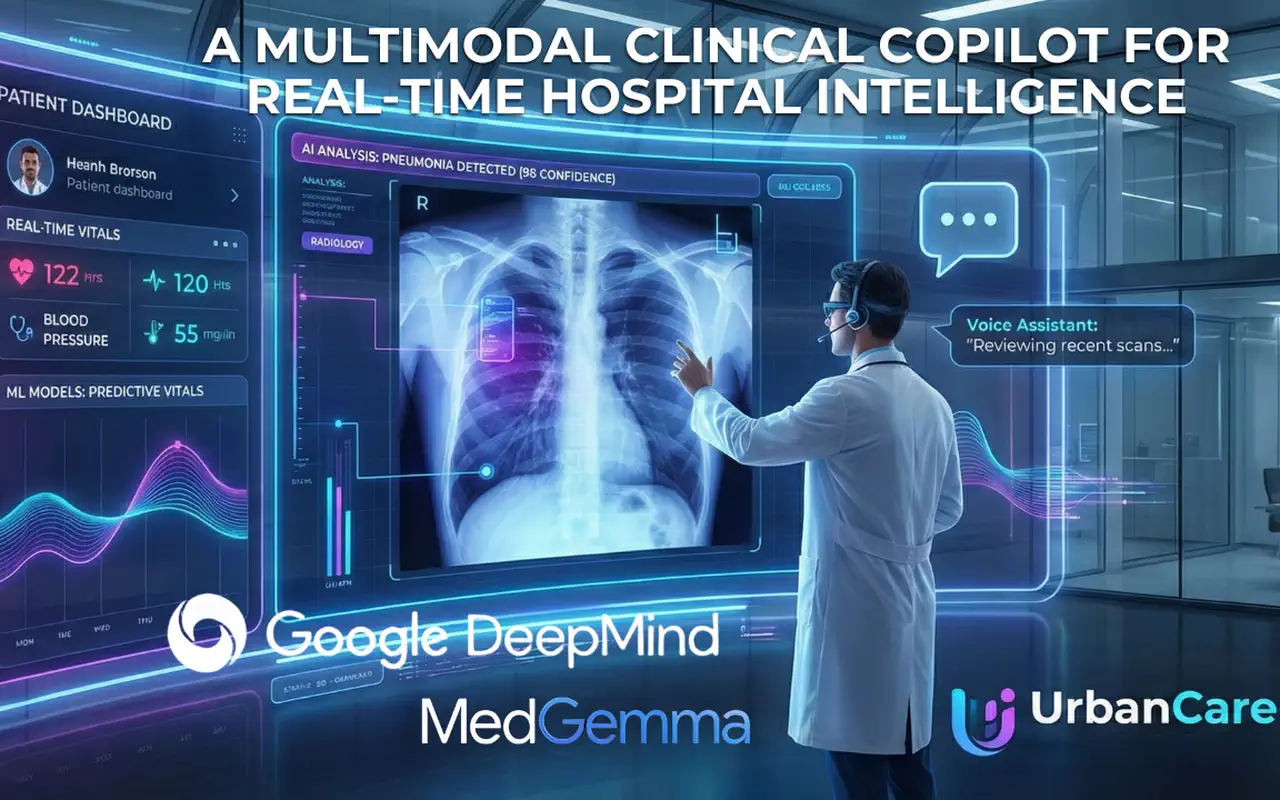
A 30-agent, 8-layer clinical pipeline built on MedGemma + TxGemma + Gemini. Provides a Semantics-to-Vector interface so physicians can inspect how medical AI models reach their diagnoses — from lab report extraction and X-ray fracture detection to differential diagnosis and voice copilot.
How it works
Production-ready AI-native clinical dashboard acting as a Doctor Consultant. Leverages Google HAI-DEF open-weight models (MedGemma 4B for vision/document tasks, TxGemma for therapeutic reasoning). Features a transparent Semantics-to-Vector interface bridging human-readable clinical semantics and internal model vectors — making AI reasoning auditable at every layer. Multi-tenant hospital platform with role-based access control, real-time vitals SSE streaming, and voice clinical copilot powered by RAG over patient memory vectors.
What I'd do differently
Interpretability isn't a feature you bolt on at the end — for clinical tools, it has to be the interface itself.
Good questions to ask
3 questions an interviewer could ask about UrbanCare AI
Why did you treat interpretability as the interface itself rather than a feature bolted on at the end?
Based on:
Interpretability isn't a feature you bolt on at the end — for clinical tools, it has to be the interface itself.
How did you bridge human-readable clinical semantics and internal model vectors to inspect the pipeline?
Based on:
A Semantics-to-Vector interface that bridges human-readable clinical semantics and internal model vectors, making every layer of the 30-agent pipeline inspectable — from lab-report extraction to differential diagnosis.
How did you address the lack of auditability that prevents compliance teams from signing off on diagnoses?
Based on:
Most clinical AI is a black box — physicians can't audit how a diagnosis was reached, so they can't trust it and compliance teams can't sign off on it.
AI-written from this site's content
AI-generated · may be wrongHow it worksPrivacy
At a glance
- Technologies
- 8
- Language
- TypeScript
- Updated
- Feb 2026
- React 19
- Node.js
- PostgreSQL
- MedGemma
- TxGemma
- Gemini
- LangChain
- GCP
- #medical-ai
- #interpretability
- #multi-agent
- #healthcare
Compare with another project
Related work
- Omni-LabAI/MLshared tech: 2 · semantic: 0.82
- Content StorytellerAI/MLshared tech: 2 · semantic: 0.78
- Vyapar-GyanAI/MLshared tech: 1 · semantic: 0.77
AI-generated · may be wrongRanked by meaning with Gemini embeddings of each write-up. Semantic is cosine similarity; 1 would be identical.How it worksPrivacy